Download Mendeley
A CK2-beta-TrCP kinase-E3 ubiquitin ligase cascade is a metabolic sensor regulating tryptophan 2,3-dioxygenase stability.
Thielen, A.S., Brauning, B., Gottemukkala, K.V., Muller, J., Prabu, J.R., Verma, P., Klaessens, S., Van den Eynde, B.J., Kleiger, G., Murray, P.J., Schulman, B.A.(2026) Mol Cell
- PubMed: 42863465 Search on PubMed
- DOI: https://doi.org/10.1016/j.molcel.2026.09.023
- Primary Citation Related Structures:
9TL5, 9TLF, 9TN8 - PubMed Abstract:
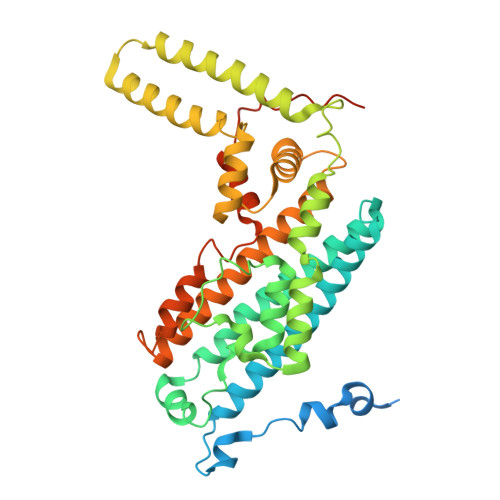
Small molecules toggling the ubiquitin-proteasome system (UPS) are powerful regulators of protein degradation, yet how endogenous ligands gate UPS decisions remains poorly understood. Here, we define control of UPS access to human tryptophan 2,3-dioxygenase (TDO2), which converts the amino acid tryptophan (Trp) to N-formylkynurenine. When Trp concentrations are limiting, TDO2 is degraded to avert hypotryptophanemia. We discovered that a CK2-β-TrCP kinase-E3 ligase cascade generates and recognizes phosphodegrons in TDO2 unless they are shielded by Trp binding at an exosite distal from the catalytic site. Effects of Trp analogs on CK2-β-TrCP-dependent ubiquitylation indicated that the indole, amino, and carboxylate groups collectively protect TDO2. Cryo-EM reveals that these moieties organize a Trp-ordered flap that covers the exosite and thereby restricts generation of adjacent phosphodegrons. In the absence of Trp, the flap is flexible, enabling phosphorylation-coupled ubiquitylation. Overall, our data uncovered an endogenous small molecule conformationally stabilizing its own metabolizing enzyme through protection from a phosphorylation-ubiquitylation cascade.
- Max Planck Institute of Biochemistry, Department of Molecular Machines and Signaling, 82152 Martinsried, Germany; Technical University of Munich, TUM School of Natural Sciences, 85748 Garching, Germany.
Organizational Affiliation: