Download Mendeley
Molecular identifiers of the evolutionarily conserved titin pseudokinase.
Dorendorf, T., Gravenhorst, P., Mayans, O.(2026) Biochem J 483: 55-70
- PubMed: 41428768
- DOI: https://doi.org/10.1042/BCJ20253442
- Primary Citation Related Structures:
9QJ2 - PubMed Abstract:
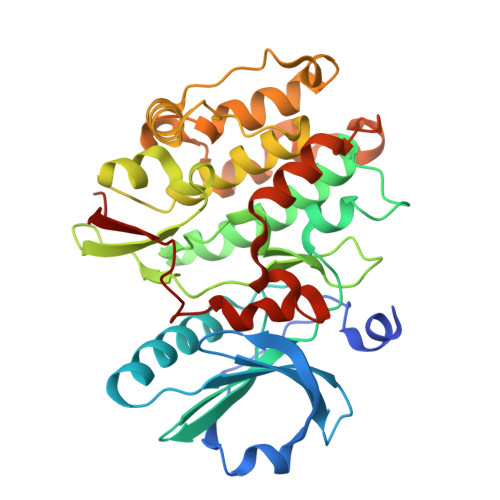
Titin kinase (TK) is an enigmatic pseudokinase specific to the striated muscle of vertebrates. Embedded within the contractile sarcomere and flanked by extensible regulatory tails, TK is thought to act as a mechanoreceptor that senses mechanical signals arising from muscle function. Studies on TK so far have focused narrowly on the human representative, whose phosphotransfer activity remains questioned. To investigate whether the pseudokinase character is a hallmark of TK, we studied sequences of distantly evolved fish representatives and rationalized conservation patterns by solving the crystal structure of TK from medaka (isoform b). We find that sequence deviations in functional motifs involved in ATP and magnesium binding, respectively θxK (θ: bulky hydrophobic residue) and EFG, are evolutionarily conserved in TK. Beyond the kinase domain, N- and C-terminal flanking tails show remarkable structural similarity across orthologues, even though sequence conservation is limited to individual residues and short motifs: a YD-motif in the N-terminal tail; a [R/K]H[R/K]RYY sequence, a R-7x-R motif and position -2 of the latter in the C-terminal tail. Motifs in the C-terminal tail consistently covary with the divergent functional motifs of TK, being part of its pseudokinase signature. Contrary with these general features, the putatively inhibitory interaction of the catalytic aspartate with a tyrosine from loop P+1 is primarily confined to mammals. Finally, based on sequence clustering analysis, we identify TK subgroupings and propose a classification of titin genes from fish into a and b isoforms (ttna and ttnb) that can assist future studies. A curated genomic annotation is provided.
- Department of Biology, University of Konstanz, Universitätsstraße 10, Konstanz, 78457, Germany.
Organizational Affiliation: