Download Mendeley
Sym024 Interacts with a Unique Epitope on the CD73 Homodimer, Favoring Effective Bivalent Binding to Improve Anti-PD-1 Therapy.
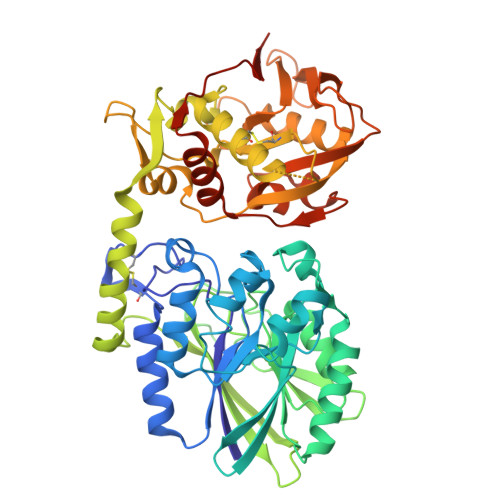
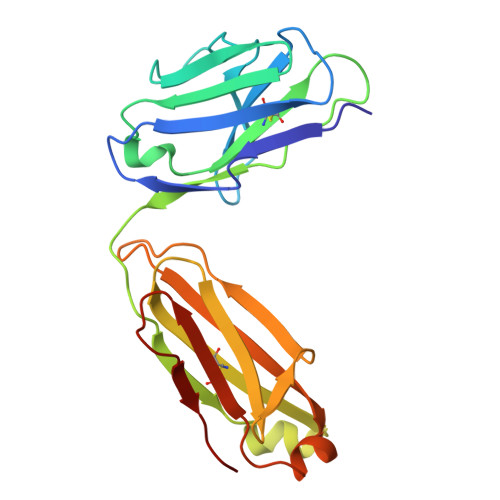
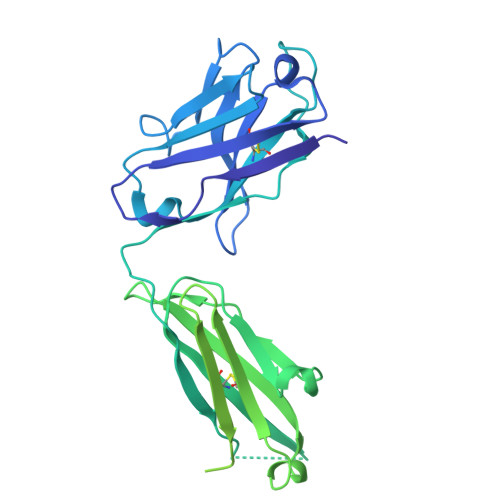
Jakobsen, J.S., Grandal, M.M., Hansen, R.W., Bansia, H., Armbruster, E., Theret, I., Skartved, N.J.O., Hald, R., Melander, M.C., Worsaae, A., Riva, M., Reckzeh, K., Vuillard, L., Lantto, J., des Georges, A., Frohlich, C.(2026) Clin Cancer Res 32: 1120-1135
- PubMed: 41511395
- DOI: https://doi.org/10.1158/1078-0432.CCR-25-2406
- Primary Citation Related Structures:
9P1M - PubMed Abstract:
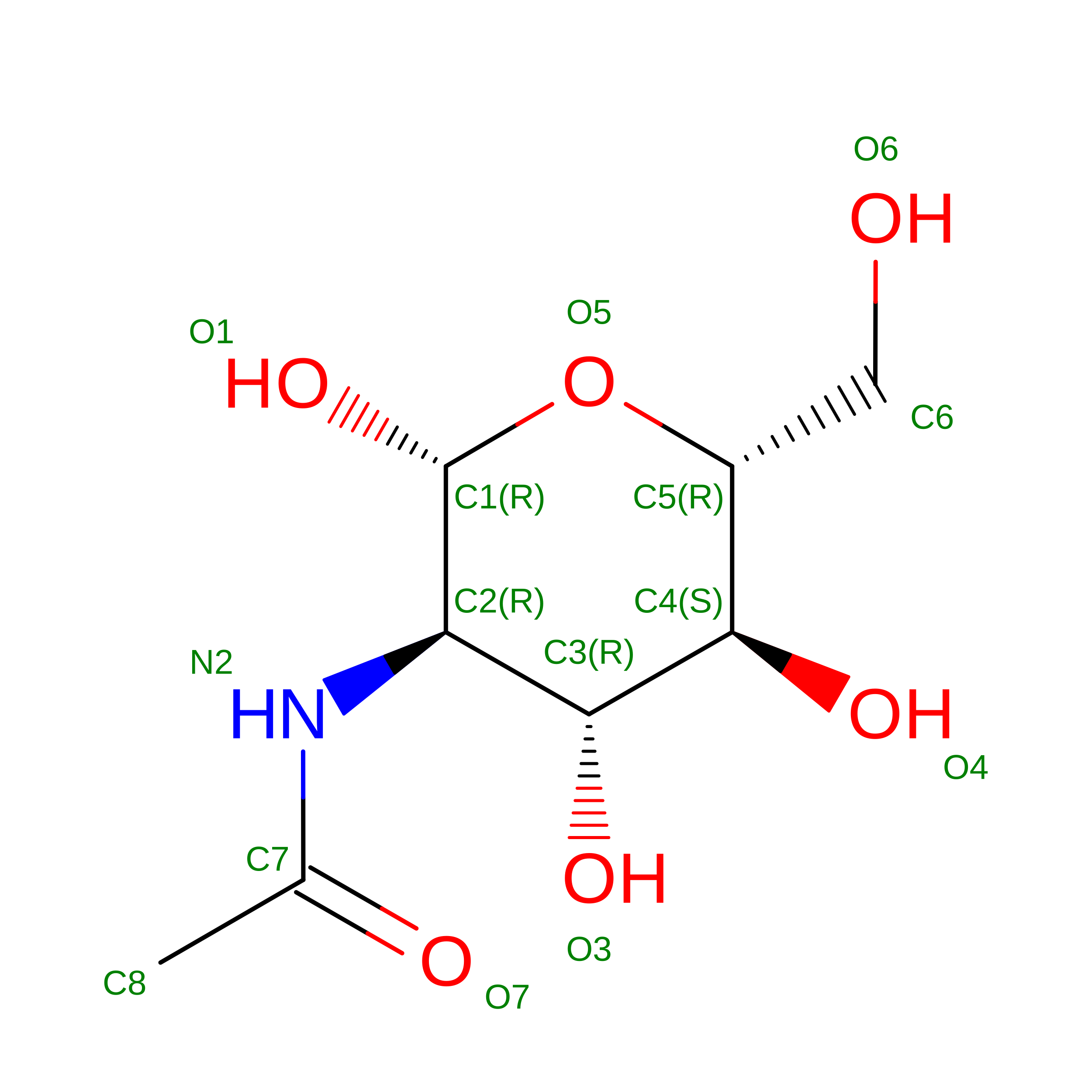
Adenosine signaling may be a central immune suppressive mechanism in several cancers, and blockade of the rate-limiting CD73 AMP-to-adenosine enzyme has been demonstrated to improve clinical efficacy of PD(L)-1 immune therapy. However, deep inhibition of CD73 activity could prove difficult in tumor environments with a constant AMP supply and high CD73 levels. Here, we sought to identify, characterize, and benchmark a novel antagonistic anti-CD73 antibody, Sym024 (S95024), and to structurally decode its mode of action. Sym024, selected via functional antibody repertoire screening, was tested against benchmark anti-CD73 antibodies in primary cell, cell line in vitro binding, CD73 enzymatic activity, and T cell activation assays. Its in vivo tumor growth inhibition was examined in transplanted human or mouse tumors in immunocompetent or immunodeficient mice, and intra-tumoral enzymatic inhibition and immune cell recruitment were assessed. We investigated Sym024-CD73 interaction using surface plasmon resonance, cryo-electron microscopy, site-directed mutagenesis, and population level complex formation through size-exclusion-chromatography with light scatter mass detection. Preclinical safety and pharmacokinetics were assessed in monkeys. Sym024 effectively blocked CD73 across a large range of enzyme expression levels, comparing favorably to benchmark anti-CD73 antibodies; it improved the efficacy of PD-1 blockade in vitro as well as in vivo. Our structural data indicate that a unique one-to-one Sym024-CD73 interaction engenders this comprehensive inhibition. No pre-clinical safety flags were observed, and the pharmacokinetics profile of Sym024 supported a standard clinical dosing regimen. The comprehensive CD73 inhibition exhibited by Sym024 may improve the efficacy of anti-PD(L)-1/anti-CD73 combination treatment.
- Servier Symphogen A/S Ballerup Denmark.
Organizational Affiliation: