11WA | pdb_000011wa

GluA2-STZ desensitized state with partial agonist NOW at 25 degrees C (full-length composite)

  • Classification: MEMBRANE PROTEIN
  • Organism(s): Rattus norvegicus, Mus musculus
  • Expression System: Homo sapiens
  • Mutation(s): No 

  • Deposited: 2026-03-15 Released: 2026-09-23 
  • Deposition Author(s): Newton, T.P., Yen, L.Y., Gangwar, S.P., Sobolevsky, A.I.
  • Funding Organization(s): National Institutes of Health/National Institute of Neurological Disorders and Stroke (NIH/NINDS), National Institutes of Health/National Institute of Arthritis and Musculoskeletal and Skin Diseases (NIH/NIAMS), National Institutes of Health/National Cancer Institute (NIH/NCI)

Experimental Data Snapshot

  • Method: ELECTRON MICROSCOPY
  • Resolution: 4.36 Å
  • Aggregation State: PARTICLE 
  • Reconstruction Method: SINGLE PARTICLE 

wwPDB Validation 3D Report Full Report

Validation slider image for 11WA

This is version 1.0 of the entry. See complete history. 

Literature

Pre-activation and gating pathway of AMPA receptors revealed by full and partial agonists.

Newton, T.P., Aktolun, M., Yelshanskaya, M.V., Alekseev, A.A., Yen, L.Y., Gangwar, S.P., Sobolevsky, I.A., Kurnikova, M.G., Sobolevsky, A.I.

(2026) Nat Struct Mol Biol 

  • DOI: https://doi.org/10.1038/s41594-026-01882-9
  • Primary Citation Related Structures: 
    11VV, 11VW, 11VX, 11VY, 11VZ, 11WA, 11WB, 11WC, 11WD, 11WE

  • PubMed Abstract: 

    AMPA receptors (AMPARs) mediate fast excitatory neurotransmission. Gating of AMPARs starts with agonist binding and transition into a non-conducting pre-active state, followed by transition into conducting open or non-conducting desensitized states. While the terminal apo, open and desensitized states have been structurally characterized, the intermediate pre-active state has remained an enigma. Compared to full agonist glutamate, partial agonists reduce the maximal occupancy of the open state and increase the probability of the pre-active state occurrence. Here we use different partial agonists and time-resolved cryo-electron microscopy (cryo-EM) to capture a structural ensemble of GluA2-γ2 AMPAR complexes in the closed apo, pre-active, open and desensitized states. Binding of partial agonists to the ligand-binding domain (LBD) results in different extents of LBD clamshell closure, with closures exceeding a threshold of ~17° resulting in the open and desensitized states and smaller closures stabilizing the pre-active state. The pre-active state has a distinct gate conformation intermediate between the other two discrete states, completely open and closed. Combined with single-channel current recordings and molecular dynamics simulations, our structural results reveal the complete gating pathway of AMPARs and shed light on the molecular mechanisms of partial agonism and pre-activation.


  • Organizational Affiliation: 
    • Department of Biochemistry and Molecular Biophysics, Columbia University, New York, NY, USA.

Macromolecule Content 

  • Total Structure Weight: 477.11 kDa 
  • Atom Count: 30,778 
  • Modeled Residue Count: 3,850 
  • Deposited Residue Count: 4,208 
  • Unique protein chains: 1

Macromolecules

Find similar proteins by:|  3D Structure
Entity ID: 1
MoleculeChains  Sequence LengthOrganismDetailsImage
Isoform Flip of Glutamate receptor 2,Voltage-dependent calcium channel gamma-2 subunit
A, B, C, D
1,052Rattus norvegicus, Mus musculus
This entity is chimeric
Mutation(s): 0 
Gene Names: Gria2, GluA2, Glur2, Cacng2, Stg
UniProt & NIH Common Fund Data Resources
Find proteins for P19491 (Rattus norvegicus)
Go to UniProtKB:  P19491
Find proteins for O88602 (Mus musculus)
Explore O88602 
Go to UniProtKB:  O88602
IMPC:  MGI:1316660
Entity Groups
Sequence Clusters30% Identity50% Identity70% Identity90% Identity95% Identity100% Identity
UniProt GroupsP19491-2O88602
Sequence Annotations
Expand
Reference Sequence

Small Molecules

Ligands 3 Unique
IDChains Name / Formula / InChI Key2D Diagram3D Interactions
POV

Query on POV


Download:Ideal Coordinates CCD File
F [auth A]
G [auth A]
I [auth B]
J [auth B]
L [auth C]
F [auth A],
G [auth A],
I [auth B],
J [auth B],
L [auth C],
M [auth C],
S [auth D],
T [auth D]
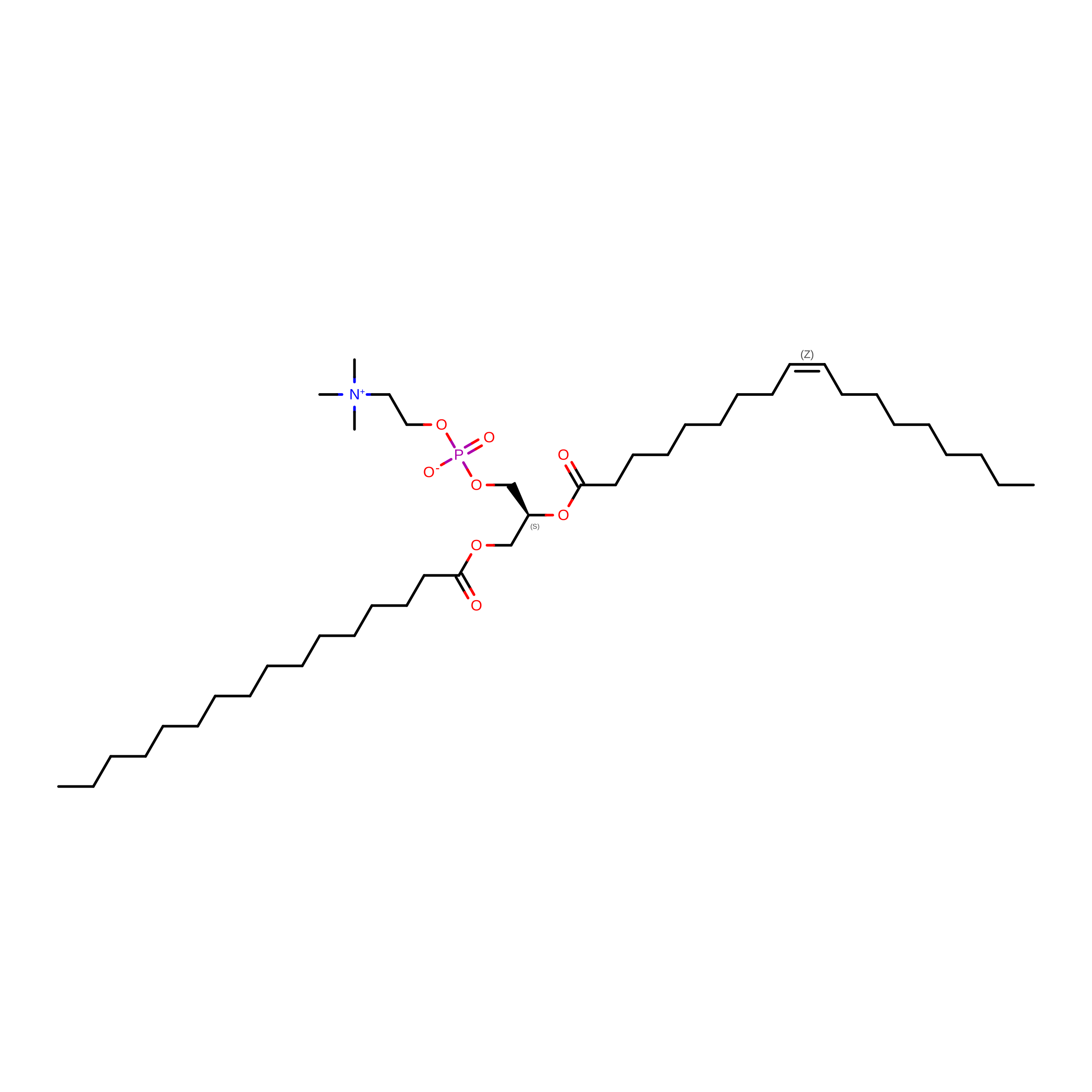
(2S)-3-(hexadecanoyloxy)-2-[(9Z)-octadec-9-enoyloxy]propyl 2-(trimethylammonio)ethyl phosphate
C42 H82 N O8 P
WTJKGGKOPKCXLL-PFDVCBLKSA-N
NWD
(Subject of Investigation/LOI)

Query on NWD


Download:Ideal Coordinates CCD File
E [auth A],
H [auth B],
K [auth C],
R [auth D]
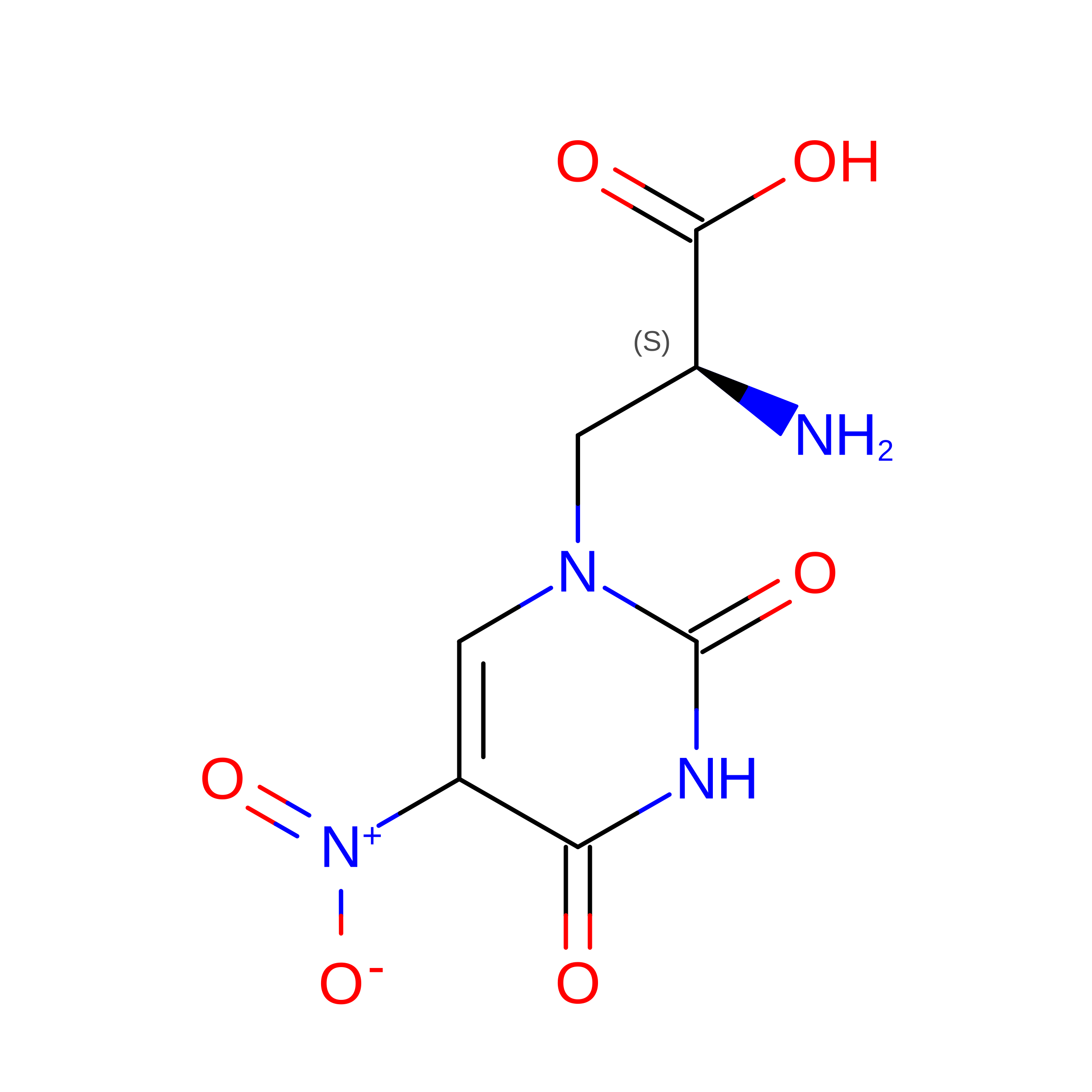
3-(5-nitro-2,4-dioxo-3,4-dihydropyrimidin-1(2H)-yl)-L-alanine
C7 H8 N4 O6
IEBVITXSHAFLJR-VKHMYHEASA-N
NA

Query on NA


Download:Ideal Coordinates CCD File
N [auth C],
O [auth C],
P [auth C],
Q [auth C]
SODIUM ION
Na
FKNQFGJONOIPTF-UHFFFAOYSA-N

Experimental Data & Validation

Experimental Data

  • Method: ELECTRON MICROSCOPY
  • Resolution: 4.36 Å
  • Aggregation State: PARTICLE 
  • Reconstruction Method: SINGLE PARTICLE 
EM Software:
TaskSoftware PackageVersion
MODEL REFINEMENTPHENIX1.11.1_2575
RECONSTRUCTIONcryoSPARC

Structure Validation

View Full Validation Report


Entry History 

& Funding Information

Deposition Data


Funding OrganizationLocationGrant Number
National Institutes of Health/National Institute of Neurological Disorders and Stroke (NIH/NINDS)United StatesF31NS147755
National Institutes of Health/National Institute of Neurological Disorders and Stroke (NIH/NINDS)United StatesNS139087
National Institutes of Health/National Institute of Neurological Disorders and Stroke (NIH/NINDS)United StatesF31NS132554
National Institutes of Health/National Institute of Neurological Disorders and Stroke (NIH/NINDS)United StatesNS083660
National Institutes of Health/National Institute of Neurological Disorders and Stroke (NIH/NINDS)United StatesNS107253
National Institutes of Health/National Institute of Arthritis and Musculoskeletal and Skin Diseases (NIH/NIAMS)United StatesAR078814
National Institutes of Health/National Cancer Institute (NIH/NCI)United StatesCA206573

Revision History  (Full details and data files)

  • Version 1.0: 2026-09-23
    Type: Initial release