Download Mendeley
Mechanism of gating and isoform-specific inhibition in renal CLC chloride channels.
Chien, C.T., Sobecks-Doherty, B.L., Powers, A.S., Das, A., Kreiter, J., Barry, C.N., Chen, M., Hinman, A., Petrakian, C.F., Williams, B., Wood, C.A.P., Xu, M., Dror, R.O., Chiu, W., Maduke, M.(2026) Proc Natl Acad Sci U S A 123: e2605886123-e2605886123
- PubMed: 42679030 Search on PubMedSearch on PubMed Central
- DOI: https://doi.org/10.1073/pnas.2605886123
- Primary Citation Related Structures:
11AH, 11AI, 11AK, 11AM, 11EU, 11EV - PubMed Abstract:
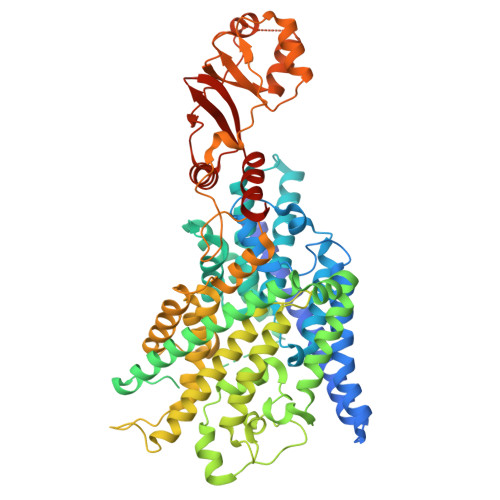
Hyponatremia is a prevalent disorder marked by excess water retention and substantial morbidity, motivating interest in the chloride channel CLC-Ka as a therapeutic target. Selectively inhibiting CLC-Ka without affecting the closely related CLC-Kb is essential for preventing serious side effects. However, developing isoform-selective inhibitors has been challenging because most small molecules do not distinguish between CLC-Ka and CLC-Kb, and the basis for selectivity in the few known exceptions remains unclear. The small molecule BIM1 preferentially inhibits CLC-Ka over CLC-Kb, providing an opportunity to dissect isoform-specific pharmacology. To investigate this mechanism, we determined cryo-EM structures of BIM1 and BIM15, a related nonselective analog, bound to a CLC-K variant engineered to match the human CLC-Ka binding pocket. Structural and computational analyses reveal that inhibition and isoform selectivity are anchored by interactions with a conserved lysine, with surrounding binding-site residues subtly tuning the local electrostatic environment to promote or disfavor these contacts. These analyses further identify a dynamic extracellular loop that intermittently occludes the shared pathway accessing the inhibitor-binding site and pore. Bound BIM15 engages this gating loop more extensively than BIM1, suggesting that differential loop engagement contributes to inhibitor selectivity, a prediction validated by mutagenesis. Because loop dynamics block the pore, we examined the structural impact of Ca 2+ , which favors opening, and found the gating loop ordered and withdrawn from the pathway. Together, these findings define how binding-site microenvironments and gating-loop dynamics shape isoform-specific inhibition and pore access in CLC-K channels.
- Department of Bioengineering, Stanford University, Stanford, CA 94305.
Organizational Affiliation: