9VBY | pdb_00009vby

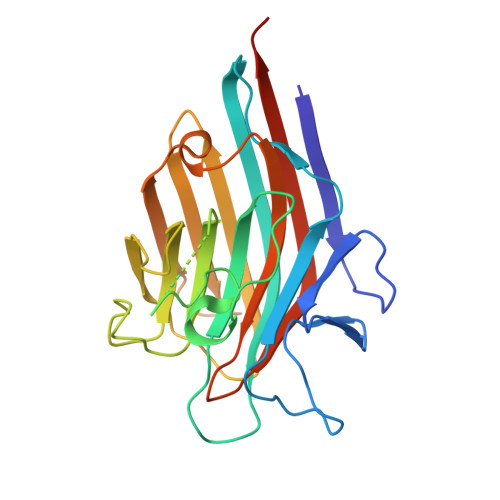
Lectin FRIL from Lablab purpureus with self glycan


Experimental Data Snapshot

  • Method: ELECTRON MICROSCOPY
  • Resolution: 2.67 Å
  • Aggregation State: PARTICLE 
  • Reconstruction Method: SINGLE PARTICLE 

Starting Model: experimental
View more details

wwPDB Validation   3D Report Full Report


This is version 1.1 of the entry. See complete history


Literature

Altering the carbohydrate-binding specificity of the legume lectin FRIL through structure-guided engineering.

Liu, Y.M.Nguyen, H.T.V.Chen, X.Shahed-Al-Mahmud, M.Chen, T.H.Liao, K.S.Lo, J.M.Kan, T.C.Ren, C.T.Ma, C.

(2026) Nat Commun 

  • DOI: https://doi.org/10.1038/s41467-026-70188-7
  • Primary Citation of Related Structures:  
    9VBW, 9VBX, 9VBY, 9VBZ, 9VC0

  • PubMed Abstract: 

    FRIL is a legume lectin from the hyacinth bean that has broad-spectrum antiviral activity. A distinctive trait of FRIL among similar mannose/glucose-specific legume lectins is that FRIL shows specificity for complex type N-glycans. We postulate that an extended binding site on FRIL facilitates this ligand selectivity. Here, we show legume lectin carbohydrate recognition domain (CRD) loop B is the main determinant of complex versus high-mannose N-glycan specificity in FRIL and Concanavalin A (ConA), respectively. First, we find that the inactive precursors of recombinant FRIL (rFRIL) and proConA (rproConA) can be activated via deglycosylation. Secondly, the cryo-EM structures of inactive apo rFRIL, active FRIL in complex with Galβ1,4-(Fucα1,3-)GlcNAcβ1,2-Man tetrasaccharide, and active rFRIL in complex with Mannose 9 GlcNAc 2 (Man9) N-glycan are determined, and residues H102 and Y101 on loop B are identified as crucial for complex glycan recognition. Finally, we swapped loop B residues 101 and 102 alongside loop C residue 145 on FRIL to their structural equivalent on ConA, resulting in a FRIL mutant that binds exclusively to high mannose N-glycans. Taken together, we have established a process of activating recombinant FRIL and related lectins through deglycosylation, and demonstrated the crucial role that loop B residues play in establishing oligosaccharide specificity.


  • Organizational Affiliation
    • Genomics Research Center, Academia Sinica, Taipei, Taiwan.

Macromolecules
Find similar proteins by:  (by identity cutoff)  |  3D Structure
Entity ID: 1
MoleculeChains Sequence LengthOrganismDetailsImage
Flt3 receptor-interacting lectin
A, B, C, D
260Lablab purpureusMutation(s): 3 
Gene Names: FRIL
UniProt
Find proteins for Q9ZTA9 (Lablab purpureus)
Explore Q9ZTA9 
Go to UniProtKB:  Q9ZTA9
Entity Groups  
Sequence Clusters30% Identity50% Identity70% Identity90% Identity95% Identity100% Identity
UniProt GroupQ9ZTA9
Sequence Annotations
Expand
  • Reference Sequence
Oligosaccharides

Help

Entity ID: 2
MoleculeChains Length2D Diagram Glycosylation3D Interactions
2-acetamido-2-deoxy-beta-D-glucopyranose-(1-2)-alpha-D-mannopyranose-(1-6)-beta-D-mannopyranoseE [auth b],
F [auth a],
G [auth c],
H [auth d]
3N/A
Small Molecules
Ligands 2 Unique
IDChains Name / Formula / InChI Key2D Diagram3D Interactions
MN (Subject of Investigation/LOI)
Query on MN

Download Ideal Coordinates CCD File 
J [auth A],
L [auth B],
N [auth C],
P [auth D]
MANGANESE (II) ION
Mn
WAEMQWOKJMHJLA-UHFFFAOYSA-N
CA (Subject of Investigation/LOI)
Query on CA

Download Ideal Coordinates CCD File 
I [auth A],
K [auth B],
M [auth C],
O [auth D]
CALCIUM ION
Ca
BHPQYMZQTOCNFJ-UHFFFAOYSA-N
Experimental Data & Validation

Experimental Data

  • Method: ELECTRON MICROSCOPY
  • Resolution: 2.67 Å
  • Aggregation State: PARTICLE 
  • Reconstruction Method: SINGLE PARTICLE 
EM Software:
TaskSoftware PackageVersion
RECONSTRUCTIONRELION3.0
MODEL REFINEMENTPHENIX1.14_3260:

Structure Validation

View Full Validation Report


Entry History & Funding Information

Deposition Data


Funding OrganizationLocationGrant Number
Academia Sinica (Taiwan)TaiwanAS-IA-113-L02
Ministry of Science and Technology (MoST, Taiwan)Taiwan110-2113-M-001-034-MY3

Revision History  (Full details and data files)

  • Version 1.0: 2026-03-18
    Type: Initial release
  • Version 1.1: 2026-03-25
    Changes: Data collection, Database references