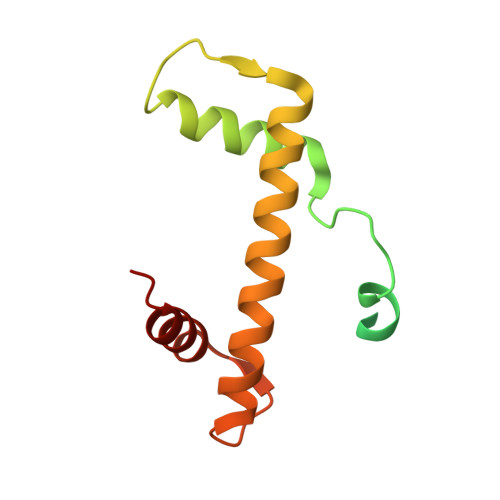
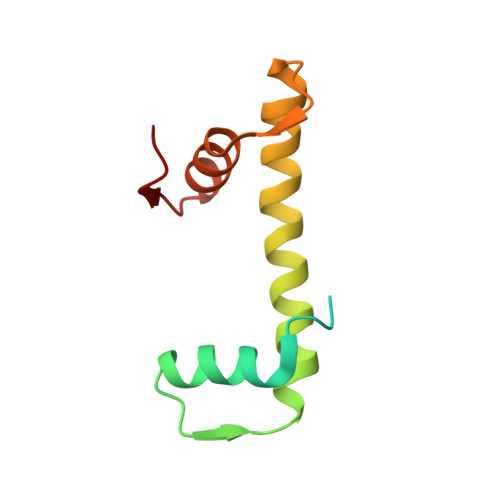
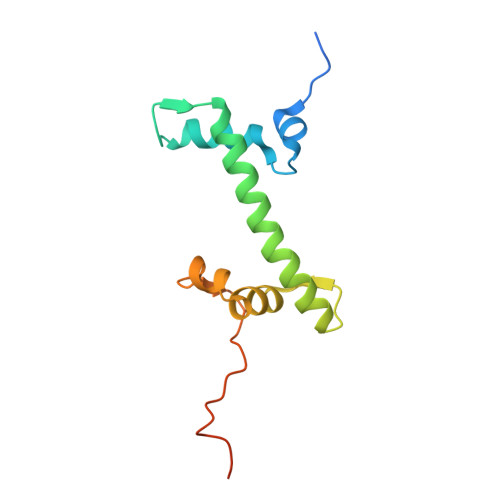
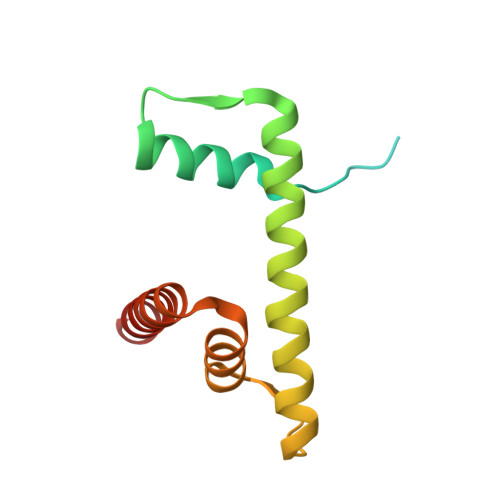
9R2W | pdb_00009r2w

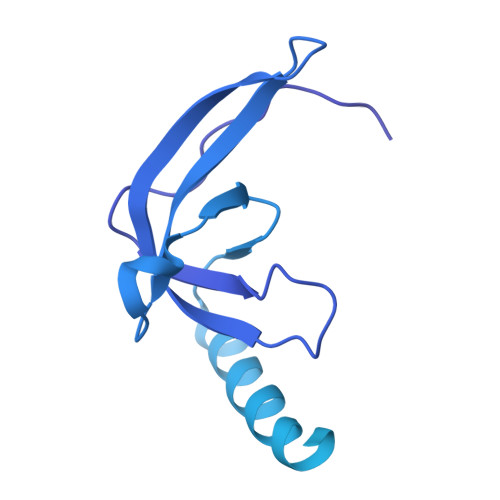
Drosophila MSL HAT nucleosome complex H3K36me3 reader state


Experimental Data Snapshot

  • Method: ELECTRON MICROSCOPY
  • Resolution: 3.40 Å
  • Aggregation State: PARTICLE 
  • Reconstruction Method: SINGLE PARTICLE 

wwPDB Validation 3D Report Full Report

Validation slider image for 9R2W

This is version 1.1 of the entry. See complete history. 

Literature

Molecular mechanism of residue-specific nucleosome acetylation.

Muller, M., Kolesnikova, O., Doudin, M., Thomae, A.W., Sparr, A.C., Krause, S., Hoffmann, T., Becker, P.B., Eustermann, S.

(2026) Mol Cell 

  • DOI: https://doi.org/10.1016/j.molcel.2026.09.019
  • Primary Citation Related Structures: 
    9R2U, 9R2W, 9R2Y

  • PubMed Abstract: 

    The male-specific lethal (MSL) complex catalyzes global acetylation of histone H4 at lysine 16, a paradigm for understanding how histone acetylation is linked to transcription and disease. However, the dynamic yet specific mechanisms governing the function of MSL histone acetyltransferase (HAT) and other HAT complexes remain largely elusive. Here, we report cryogenic-electron microscopy (cryo-EM) structures of the Drosophila MSL complex engaged during active catalysis, revealing how nucleosomes are acetylated in a residue-specific manner. Unlike typical enzyme-substrate complexes, a stable product state is observed, directly visualizing the acetyl group being transferred from coenzyme A to H4K16. The cooperative interplay of MSL subunits acts as a molecular ruler conferring specificity, while recognition of H3K36 trimethylation accelerates enzymatic activity, linking MSL function to transcriptionally active gene bodies. We establish physiological relevance of this mechanism in Drosophila dosage compensation. These findings uncover molecular principles underlying the specificity and regulation of histone acetylation in transcriptionally active chromatin.


  • Organizational Affiliation: 
    • Department of Molecular Biology, Biomedical Center (BMC), LMU Medizin, Ludwig-Maximilians-Universität München, Planegg-Martinsried 82152, Germany. Electronic address: marisa.mueller@bmc.med.lmu.de.

Macromolecule Content 

  • Total Structure Weight: 307.63 kDa 
  • Atom Count: 12,046 
  • Modeled Residue Count: 1,094 
  • Deposited Residue Count: 1,950 
  • Unique protein chains: 5
  • Unique nucleic acid chains: 2

Macromolecules


Find similar proteins by:|  3D Structure
Entity ID: 1
MoleculeChains  Sequence LengthOrganismDetailsImage
Histone H3.1
A, E
135Homo sapiensMutation(s): 0 
Gene Names: 
UniProt & NIH Common Fund Data Resources
Find proteins for P68431 (Homo sapiens)
Explore P68431 
Go to UniProtKB:  P68431
Entity Groups
Sequence Clusters30% Identity50% Identity70% Identity90% Identity95% Identity100% Identity
UniProt GroupP68431
Sequence Annotations
Expand
Reference Sequence
Find similar proteins by:|  3D Structure
Entity ID: 2
MoleculeChains  Sequence LengthOrganismDetailsImage
Histone H4
B, F
102Homo sapiensMutation(s): 0 
Gene Names: 
UniProt & NIH Common Fund Data Resources
Find proteins for P62805 (Homo sapiens)
Explore P62805 
Go to UniProtKB:  P62805
Entity Groups
Sequence Clusters30% Identity50% Identity70% Identity90% Identity95% Identity100% Identity
UniProt GroupP62805
Sequence Annotations
Expand
Reference Sequence
Find similar proteins by:|  3D Structure
Entity ID: 3
MoleculeChains  Sequence LengthOrganismDetailsImage
Histone H2A type 1-C
C, G
129Homo sapiensMutation(s): 0 
Gene Names: H2AC6, H2AFL, HIST1H2AC
UniProt & NIH Common Fund Data Resources
Find proteins for Q93077 (Homo sapiens)
Explore Q93077 
Go to UniProtKB:  Q93077
PHAROS:  Q93077
GTEx:  ENSG00000180573 
Entity Groups
Sequence Clusters30% Identity50% Identity70% Identity90% Identity95% Identity100% Identity
UniProt GroupQ93077
Sequence Annotations
Expand
Reference Sequence
Find similar proteins by:|  3D Structure
Entity ID: 4
MoleculeChains  Sequence LengthOrganismDetailsImage
Histone H2B type 1-C/E/F/G/I
D, H
125Homo sapiensMutation(s): 0 
Gene Names: HIST1H2BC, H2BFL, HIST1H2BE, H2BFH, HIST1H2BF, H2BFG, HIST1H2BG, H2BFA, HIST1H2BI, H2BFK
UniProt & NIH Common Fund Data Resources
Find proteins for P62807 (Homo sapiens)
Explore P62807 
Go to UniProtKB:  P62807
Entity Groups
Sequence Clusters30% Identity50% Identity70% Identity90% Identity95% Identity100% Identity
UniProt GroupP62807
Sequence Annotations
Expand
Reference Sequence
Find similar proteins by:|  3D Structure
Entity ID: 7
MoleculeChains  Sequence LengthOrganismDetailsImage
Protein male-specific lethal-3K [auth N]518Drosophila melanogasterMutation(s): 2 
Gene Names: msl-3, CG8631
UniProt
Find proteins for P50536 (Drosophila melanogaster)
Explore P50536 
Go to UniProtKB:  P50536
Entity Groups
Sequence Clusters30% Identity50% Identity70% Identity90% Identity95% Identity100% Identity
UniProt GroupP50536
Sequence Annotations
Expand
Reference Sequence
Find similar nucleic acids by:  (by identity cutoff) 
Entity ID: 5
MoleculeChains LengthOrganismImage
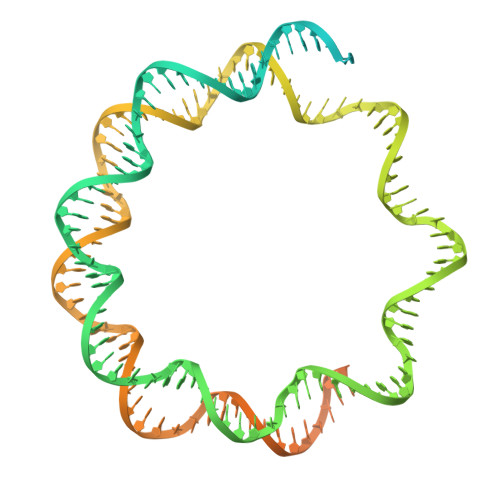
DNA225synthetic construct
Sequence Annotations
Expand
Reference Sequence
Find similar nucleic acids by:  (by identity cutoff) 
Entity ID: 6
MoleculeChains LengthOrganismImage
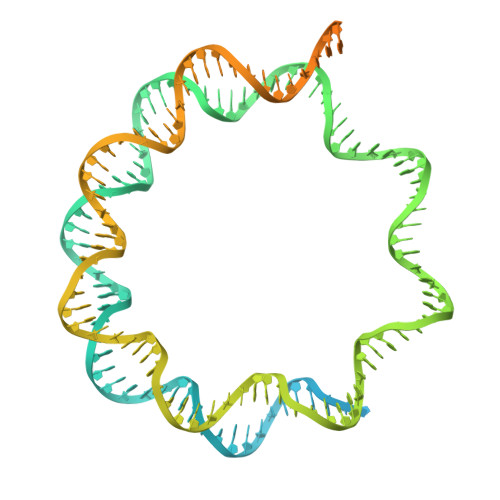
DNA225synthetic construct
Sequence Annotations
Expand
Reference Sequence

Small Molecules

Modified Residues  1 Unique
IDChains Modified ResidueModification TypeFormula2D Diagram
M3L
Query on M3L
LYSMethylationC9 H21 N2 O2
Non-standard Monomers  1 Unique
IDChains TypeFormula2D Diagram
ALY
Query on ALY
B, F
L-PEPTIDE LINKINGC8 H16 N2 O3

Experimental Data & Validation

Experimental Data

  • Method: ELECTRON MICROSCOPY
  • Resolution: 3.40 Å
  • Aggregation State: PARTICLE 
  • Reconstruction Method: SINGLE PARTICLE 
EM Software:
TaskSoftware PackageVersion
MODEL REFINEMENTPHENIX1.21.1_5286
RECONSTRUCTIONcryoSPARC

Structure Validation

View Full Validation Report


Entry History 

& Funding Information

Deposition Data


Funding OrganizationLocationGrant Number
German Research Foundation (DFG)GermanyBe1140/9-1
German Research Foundation (DFG)GermanyBe1140/11-1
Boehringer Ingelheim Fonds (BIF)Germany--

Revision History  (Full details and data files)

  • Version 1.0: 2026-10-14
    Type: Initial release
  • Version 1.1: 2026-10-28
    Changes: Data collection, Database references