Download Mendeley
Regulating the orientation of homobivalent small binders through 3D domain-swapping design.
Shiga, S., Watanabe, H., Makabe, K., Honda, S.(2025) J Biological Chem 302: 111053-111053
- PubMed: 41391770
- DOI: https://doi.org/10.1016/j.jbc.2025.111053
- Primary Citation Related Structures:
9KL7, 9KLS, 9KLT, 9KLU - PubMed Abstract:
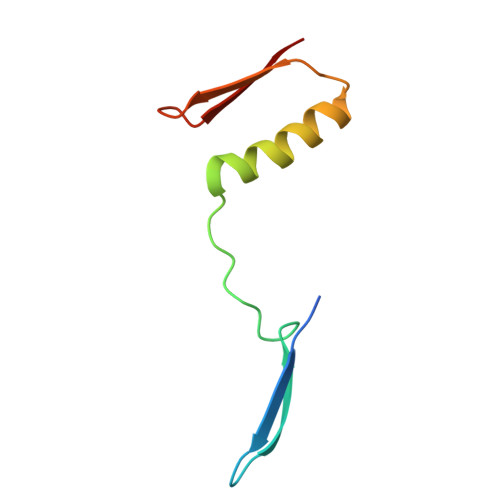
Homobivalent small binders represent bioactive dimeric proteins constructed by linking nanobodies or other small binders. As binding domain orientation in these dimeric binders affects binding affinity, expanding the orientation regulation techniques is crucial for optimizing their performance. Here, we report a 3D domain-swapping design as a genetic engineering approach to regulate the orientation of homobivalent small binders. We aimed to regulate B1 domain orientation of protein G as a model binder. By inserting single cysteine-containing polyproline sequences into loops located at the C- and N-terminal sides of the tertiary structure, we successfully designed 3D domain-swapped dimers with tail-to-tail and head-to-head orientations. Notably, the head-to-head-oriented dimer demonstrated potential as a functional homobivalent small binder. Our results highlight the applicability of the 3D domain-swapping design for regulating the orientation of homobivalent small binders and establish a foundation for developing 3D domain-swapped dimers.
- Molecular Biosystems Research Institute, National Institute of Advanced Industrial Science and Technology (AIST), Tsukuba, Ibaraki, Japan; Graduate School of Science and Engineering, Yamagata University, Yonezawa, Yamagata, Japan.
Organizational Affiliation: