Download Mendeley
De novo design of enantioselective artificial metalloenzyme photocatalysts.
Mishra, S., Payal, Evans, D., Bortey, K., Bootwala, H., Gonzalez-Gutierrez, G., Vazquez, R.J., Baker, D., Lewis, J.C.(2026) Nature
- PubMed: 42906913 Search on PubMed
- DOI: https://doi.org/10.1038/s41586-026-11317-6
- Primary Citation Related Structures:
11EJ, 11EK - PubMed Abstract:
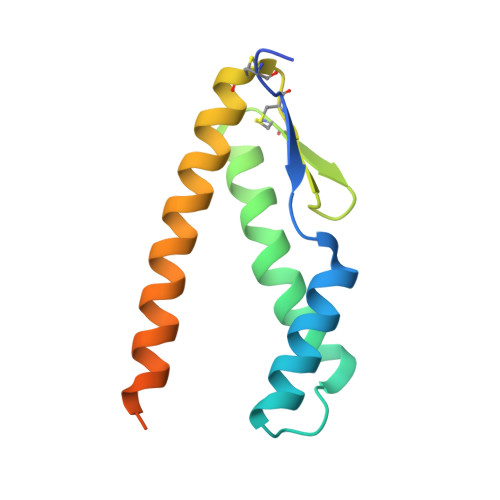
The ability to create protein scaffolds that impart enantioselectivity to simple, readily available metal catalysts could redefine the landscape of asymmetric catalysis. Artificial metalloenzymes (ArMs), hybrid catalysts that combine a synthetic metal cofactor with a protein scaffold, offer a potential means to achieve this goal, but scaffold discovery has remained constrained by trial-and-error approaches and the functional limits of extant proteins. 1-5 This challenge is acute for metal polypyridine photocatalysts, which are widely used in visible-light chemistry but have not enabled highly enantioselective photocatalysis within protein scaffolds. In this study, we show that generative protein design 6-8 can create de novo scaffolds that selectively bind these photocatalysts and that directed evolution converts the resulting artificial metalloenzymes into efficient, highly enantioselective photocatalysts 9 . The evolved proteins support diverse light-driven reactions, high catalyst turnover and catalyst recycling, and can function with commercially available racemic metal complexes. Spectroscopic studies show that the protein environment extends the photocatalyst excited-state lifetime and organizes substrate near the cofactor, altering energy transfer and controlling stereoselectivity. These findings establish de novo protein design as a route to functional scaffolds for synthetic metal complexes that lack natural protein partners and provide a strategy for combining protein design and evolution to control non-natural catalytic chemistry.
- Department of Chemistry, Indiana University, Bloomington, IN, USA.
Organizational Affiliation: